

Families can stay connected abroad by setting up each device separately before departure, confirming that every phone is compatible with the destination network, and assigning one line or profile per traveler rather than trying to share a single phone profile. The safest approach is to pair carrier roaming decisions with individual messaging and call plans, then agree on a simple meeting routine in case service is uneven on arrival.
Start with device-by-device compatibility
Before travel, the FCC advises checking with the carrier to confirm whether each phone will work in the country being visited, because mobile networks differ by country and a device may be incompatible abroad. The FCC also notes that even when voice works, data or text messaging may still fail on some networks.
Apple's Dual SIM guidance shows that supported iPhone models can use one physical SIM and one eSIM, and newer models can use two eSIMs, but the available setup depends on the exact model. On iPhone, the cellular settings let a user add lines, choose a default line for cellular data, and select a default voice line.
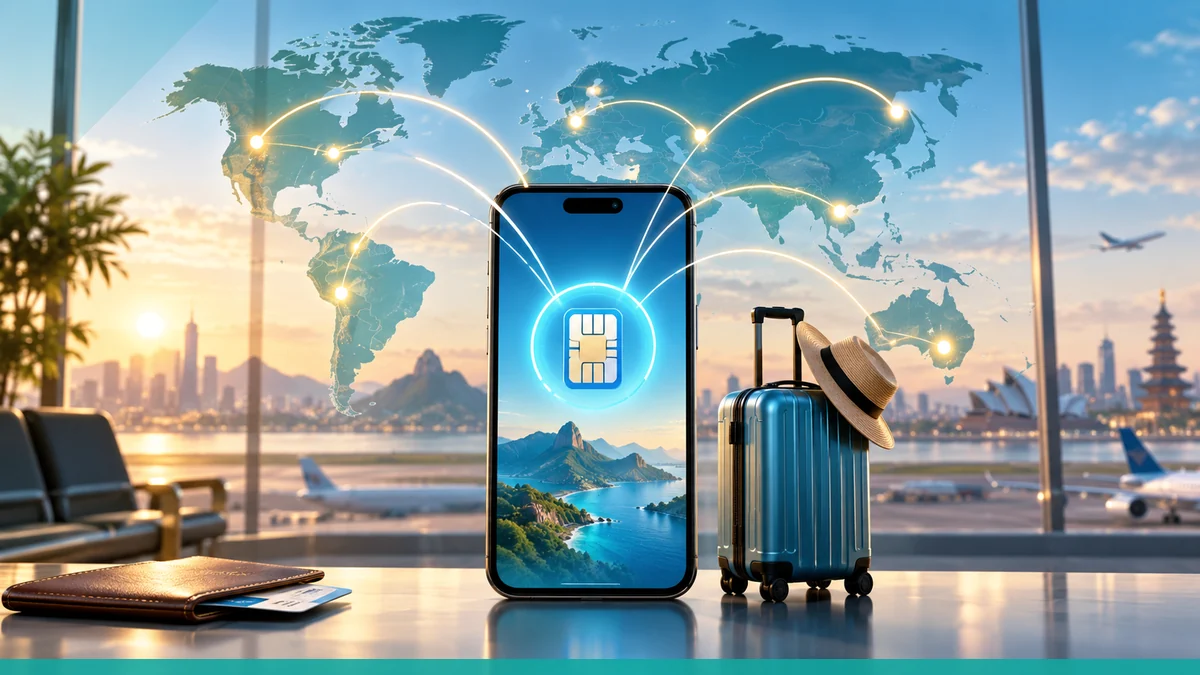
uPhone describes its global travel eSIM plans as a single digital SIM profile that works across 150+ countries, which makes it suitable for a traveler who wants one plan on one device rather than a shared family profile.
Give each traveler a separate line or profile
Families should treat roaming as an individual setup for each device. Apple’s Dual SIM guidance is organized around adding lines and selecting which line handles data and voice on a single iPhone, which supports a one-device, one-user approach.
That separation matters because the FCC says roaming rates and functions can vary by country, network, and service type. If one traveler is using a local SIM or eSIM and another is using carrier roaming, each person may have different calling, texting, and data behavior.
- Confirm each phone is unlocked if a local SIM or eSIM will be used.
- Confirm each device supports the needed SIM type or eSIM setup.
- Set the preferred data line on each device before departure.
- Keep voice and messaging expectations separate for every traveler.
Use messaging and calling apps as the backup plan
The FCC says travelers may be able to avoid or reduce voice roaming charges by using calling apps that rely on VoIP over free Wi-Fi. That makes Wi-Fi-based messaging and calling a practical backup when cellular service is expensive, unavailable, or inconsistent.
Travelers should also remember that the FCC warns roaming charges can apply to voice calls, voicemail, texts, and internet access, and the cost can be much higher on foreign networks. Families should therefore decide in advance which app will be the main contact tool and which numbers will be used only for emergencies or account verification.
Make a family meeting plan before arrival
A simple meeting plan reduces the pressure to stay constantly connected while sorting out roaming, eSIM activation, or local coverage after landing. The plan should specify one primary messaging app, one backup app, and one fixed check-in time each day.
It should also define where to meet if a phone loses service, battery, or data access. Because the FCC says service behavior can vary and some functions may not work even if the phone itself works, families should not depend on a single number or a single device to keep everyone together.
- Pick one daily check-in time.
- Share hotel, port, station, and excursion meeting points in advance.
- Save each family member’s local and home numbers in every phone.
- Agree on a “no signal” fallback location.
Check settings before boarding and again after arrival
Apple’s Dual SIM guidance says the default cellular data line can be changed in Settings, and cellular data switching can be allowed or disabled depending on the setup. For travelers using an iPhone with Dual SIM, those settings should be reviewed before departure so the wrong line is not used unexpectedly.
The FCC says travelers should understand roaming rules and rates before they travel, and should check with the provider to confirm international roaming arrangements before departure. If the family intends to use Wi-Fi calling or VoIP, it should be tested before leaving home rather than first trying it in transit or after landing.
After arrival, each traveler should verify that data, voice, and messaging work on the intended line or app. If one device fails, the fallback should be to switch to Wi-Fi-based messaging or the prearranged meeting point rather than assuming service will recover immediately.
What to remember when choosing a roaming approach
Families do not need one shared roaming pass to stay connected. They do need separate device plans, a clear understanding of carrier rules, and a backup communication method for each traveler.
- Use one setup per phone, not one shared phone profile.
- Check carrier compatibility and roaming rules before departure.
- Use messaging and VoIP over Wi-Fi as a backup when appropriate.
- Write down meeting times and places in case mobile service is inconsistent.
For additional first-party detail relevant to this topic, consult FCC's international roaming guidance.
More eSIM resources: Browse our eSIM guides and troubleshooting resources for compatibility, setup, travel-data and account-safety advice.
Related travel guides: Travel eSIM Guide: Choosing, Installing and Using an eSIM Abroad, How to Keep WhatsApp, iMessage and Your Home Number While Abroad, and Travel eSIM vs Local SIM vs International Roaming.
