

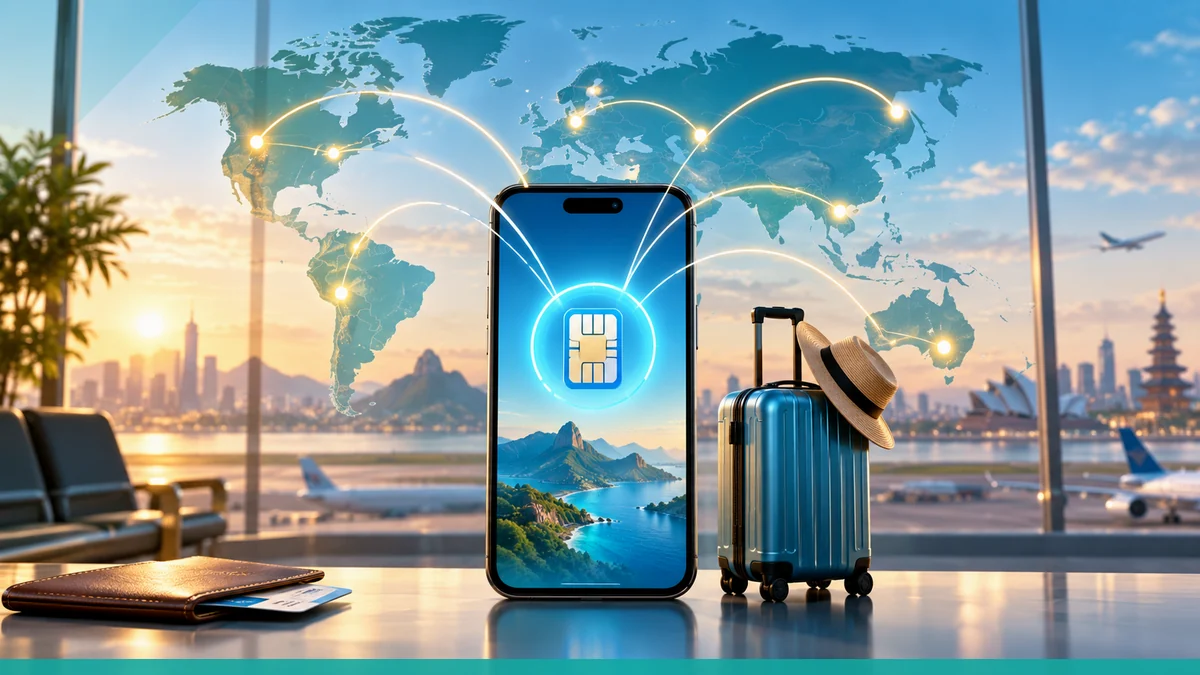
Use an eSIM for travel only after checking whether your device, carrier, and destination support it, because roaming, local eSIM activation, and coverage rules differ by country and by plan. Apple says international eSIM travel on iPhone can use prepaid data plans from worldwide providers, and the FCC says unlocking your phone can let you use a local SIM or embedded eSIM in the country you are visiting.
Before departure: confirm coverage and compatibility
uPhone’s global eSIM coverage is described as spanning 150+ countries, including all of Europe, North America, most of Asia-Pacific, the Middle East, Latin America, and major African destinations. uPhone also says coverage can vary slightly between plans, so the exact country list should be checked for the specific product you are buying.
- Global and regional plans may cover multiple countries on one eSIM.
- Country-specific plans work only in that country.
- uPhone says its North America eSIM is for the United States, Canada, and Mexico, while its U.S. plan does not cover Canada, Mexico, or U.S. territories such as Puerto Rico, Guam, or the U.S. Virgin Islands.
Apple says travelers should confirm that their wireless provider or worldwide service provider supports eSIM on the iPhone, and that the iPhone must be connected to Wi-Fi or a hotspot to activate in many cases. Apple also notes that in some countries or regions, eSIM-only iPhone models can activate without Wi-Fi.
During layovers: know when the plan is active
For layovers, the key question is whether your plan is active in the country where you are physically located. If the stop is in a country included in your eSIM plan, data service should be available there; if the stop is outside the covered area, a country-specific plan will not apply and a separate eSIM may be needed.
Apple says some home plans already include international roaming on select data plans without additional fees, so travelers should check with their carrier before departure. The FCC likewise advises checking with your provider before travel because networks differ from country to country and some data or text functions may not work even if voice calling does.
On cruises: watch for maritime networks
Maritime connectivity is different from land-based roaming, so cruise ship network use should not be assumed to work like ordinary international roaming. Travelers should verify whether the cruise line’s shipboard network is supported by their mobile plan or whether it will count as a separate roaming environment.
When a ship is at sea, the country coverage of a land eSIM may not apply until the vessel is back in port or within a supported terrestrial network area. For port days, the applicable line is the one that matches the country where the ship has docked.
At border crossings: coverage changes with location
Apple's international eSIM guidance says travelers can use prepaid plans from worldwide providers, and the FCC notes that an embedded eSIM can function like a local phone in the country you are visiting. That means the active line depends on the country you are in, not just the route you are taking.
If a journey crosses into a country outside your plan’s list, service may stop when the device leaves the covered area. uPhone explicitly says its U.S. plan stops at the U.S. border, so crossing into neighboring countries requires a separate eSIM or plan.
Device, carrier, and region differences
Apple says some iPhone models sold in the United States can activate with many carriers worldwide that support eSIM on iPhone, and Apple also says carrier support should be confirmed directly with the carrier. The FCC says unlocking the phone can enable use of a SIM card or embedded eSIM abroad.
- Check whether your device is unlocked before departure.
- Check whether your carrier includes international roaming on your plan.
- Check whether the destination country appears in the eSIM’s coverage list.
- Check whether activation requires Wi-Fi or a hotspot.
What to do if service does not start
If service does not begin after arrival, Apple’s guidance points to provider confirmation and Wi-Fi-based activation as the first checks. The FCC’s guidance also makes clear that roaming rules and rates should be understood before travel, since network compatibility and availability vary by destination.
For travelers using a provider plan, the practical order is to confirm the device is unlocked, confirm the plan includes the country, and confirm the carrier or eSIM provider supports activation for that device and region. If the plan is not documented for the country you are entering, do not assume it will work there.
For additional first-party detail relevant to this topic, consult FCC's international roaming guidance.
More eSIM resources: Browse our eSIM guides and troubleshooting resources for compatibility, setup, travel-data and account-safety advice.
Related travel guides: Travel eSIM Guide: Choosing, Installing and Using an eSIM Abroad and Multi-Country eSIM Guide for a European Trip.
