

The Travelers’ Guide to Using Emojis When Words Fail Abroad
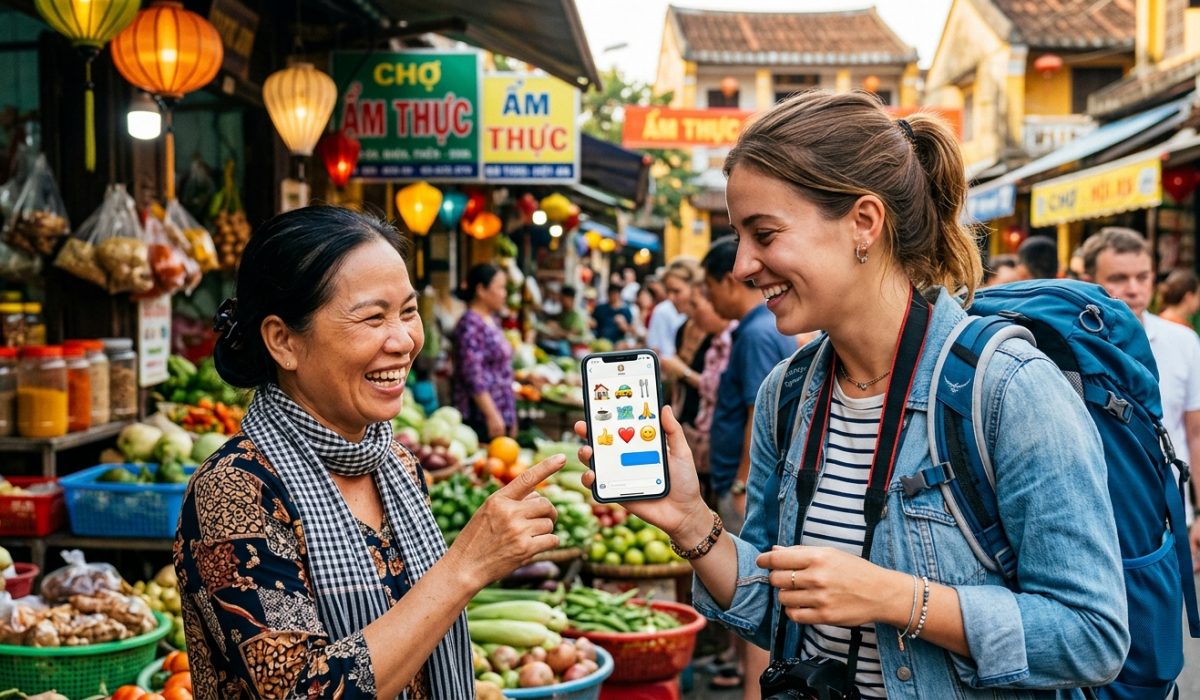
You are standing at a street food stall in Chiang Mai. The vendor smiles. You smile back. You have absolutely no idea how to say “no peanuts, please” in Thai, and your translation app just crashed. You point at the dish, shake your head, mime something that might look like a nut, and hope for the best. Most travelers have been exactly here, in this moment of friendly, slightly desperate pantomime. What if your phone could do the miming for you?
Key Takeaways:
– A shared visual shorthand has made emoji a genuine communication tool for travelers, not just a social media accessory.
– Travel emojis cover planes, trains, landmarks, and weather icons that cross language lines instantly.
– The Unicode Consortium standardized emoji so they render consistently across Android and iOS devices worldwide.
– Group travelers use emoji combos to build expressive itinerary messages and social captions.
– Pairing a visual symbol with a translation app or photo is more reliable than text alone in many situations.
When Words Disappear, Pictures Stay
There is a reason road signs use images instead of text. A red circle with a diagonal slash means “no” in nearly every country on earth. Emoji work on the same principle. They bypass the need for a shared spoken language and tap into something more fundamental: visual recognition.
The taxi driver who cannot read your hotel’s name written in Roman letters will almost certainly understand a map pin emoji followed by a building icon. The pharmacist who speaks no English will understand a pill emoji or a thermometer. A flight attendant from any country will know exactly what you mean when you tap a water droplet and point to your cup.
This is not a workaround. It is a genuinely useful communication layer, and seasoned backpackers have known it for years.
The Visual Vocabulary Every Traveler Needs
Not all emoji are equal for travel purposes. The ones that earn their place in your toolkit fall into a few practical categories.
Transport symbols are the most immediately useful. The airplane, train, bus, taxi, ferry, and bicycle emoji give you an instant way to ask “how do I get there?” without speaking a word. Pair one with a clock and a number and you have a rough departure time question. Combine a taxi with a map pin and you have a destination request.
Food and allergy communication is trickier in text but clearer in pictures. A shrimp emoji, a shaking head, and a face showing discomfort is clumsy English grammar but perfectly clear visual logic. The same works for peanuts, dairy, and meat. You are not writing a sentence. You are telling a story in three images.
Weather icons matter more than people expect. Planning a hiking day? A sun icon, a boot, and a mountain can ask a local guide whether the trail is good today. A rain cloud and a question mark gets you a forecast check without any shared words.
Landmark and place symbols anchor your location requests. The Statue of Liberty, Big Ben, the Eiffel Tower, and dozens of other recognizable structures exist as emoji precisely because travelers needed them. Even generic symbols like “castle,” “temple,” and “mosque” carry enough meaning to orient a conversation.
For a full breakdown of what is actually in the travel category, the complete library of travel emojis covers planes, trains, weather, and landmarks in one organized reference.
Why These Symbols Work Across Every Phone
Here is the part that matters technically, even if you never think about technology while traveling. Emoji look different on different devices. A grinning face on an iPhone looks slightly different from the same code on a Samsung. But the meaning stays the same, because of one important organization.
The Unicode Consortium is a nonprofit that maintains the universal standard for how text characters, including emoji, are encoded and transmitted across platforms. When you send a taxi emoji from your Android to your iPhone-using travel companion, both of you see a taxi. The visual style changes. The meaning does not. This is not an accident. It is the result of deliberate, international standardization that makes emoji genuinely reliable as a cross-platform visual language.
That reliability is what gives emoji their usefulness in travel contexts. You can hand your phone to someone with any device and trust that what you are showing them is what they will see.
The Art of the Travel Emoji Conversation
Using a single emoji is a start. Building a short sequence is a communication upgrade.
The trick is to think in subject-verb-object, just as you would in a sentence, but with pictures instead of words. Here is a practical framework travelers use:
- Start with the subject: show what you are talking about (a bus, a restaurant, a hotel building).
- Add the action: show what you want to do (an arrow for direction, a ticket for buying, a fork for eating).
- Close with context: add a time icon, a location pin, or a question mark to complete the idea.
This three-part structure keeps your message readable to someone with no English at all. You are not expecting them to parse grammar. You are giving them a visual flow they can follow intuitively.
Group Travel and the Shared Itinerary
Travel with friends introduces a different use case entirely. The conversation is not with a stranger who speaks another language. It is with your own group, across a chat thread that is moving fast, that everyone half-reads while waiting for luggage or standing in a museum queue.
Emoji sequences shine here. A plane followed by a hotel followed by a sunset and a drinks symbol is a faster itinerary summary than three sentences of text. A beach umbrella, a camera, and a clock says “photo spot, afternoon” without anyone having to write it out. These compressed messages are genuinely faster to read in a noisy group chat, and they land better as social captions when the trip is over.
Building these sequences takes a little practice, but it also takes a good reference. For anyone putting together creative itinerary messages or group chat updates, a catalog of emoji combos gives you ready-made sequences and inspiration for building your own.
The social side of travel has also changed how people document experiences. A caption in a single line of emoji is now a recognizable format, something audiences understand and engage with. Travelers who use this fluently are not just communicating. They are building a visual style that travels as well as they do.
How to Build Your Emoji Travel Kit Before You Leave
Preparation makes the difference between fumbling through emoji menus in a stressful moment and pulling up exactly the right symbol in two seconds.
Before your trip, spend ten minutes browsing the emoji categories relevant to your destination. Save your most-used travel symbols as a note or a pinned message to yourself. If you are going somewhere with a specific local food, find the closest emoji equivalent. If your trip involves boats, trains, and mountain hikes, make sure you know where those symbols live on your keyboard.
Some travelers screenshot their key emoji sequences, their hotel address in local script alongside a map pin emoji, their dietary restrictions in picture form, their transport preferences, and store them in an accessible album. This takes three minutes and saves enormous friction at customs, at restaurants, and at taxi stands.
A translation app and an emoji library are not competing tools. They are complements. The app handles precision. The emoji handle warmth, speed, and the moments when the app is too slow or the signal is too weak.
Your Phone Is Already a Universal Translator
The technology was never the missing piece. The missing piece was recognizing that emoji are not decorative. They are functional. They are the closest thing most travelers have to a universal visual alphabet, one that has been standardized by an international body, adopted by every major platform, and understood intuitively by billions of people across cultures and languages.
Your phone has that alphabet built in. The next time a waiter looks at you blankly, the next time a taxi driver cannot find your destination on a hand-written note, open the emoji keyboard. Think in pictures. Show rather than say. The conversation you manage to have, across a complete language gap, with nothing but a handful of small icons, will be one of the unexpected joys of traveling in the modern world.
