

Why Transcripts Are Becoming a Standard Part of Travel Vlog Production
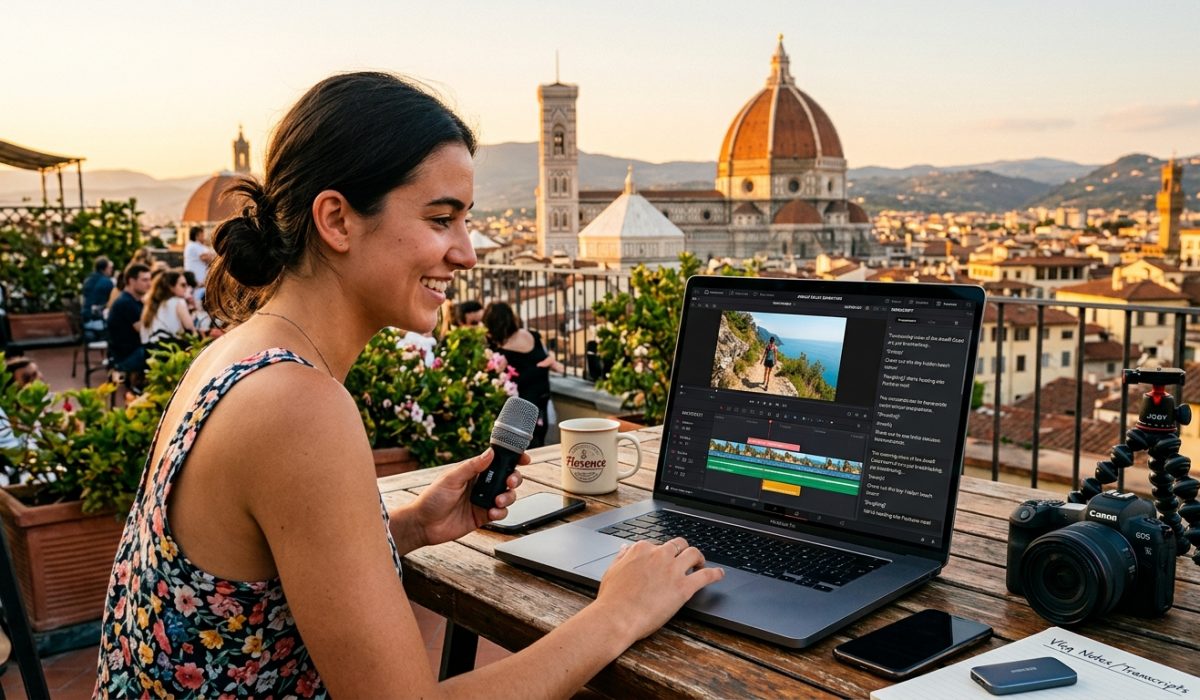
You spend a week in Lisbon. You film the tram rides, the pastéis de nata, the view from São Jorge Castle at golden hour. You edit it all into a 12-minute YouTube video, upload it, and wait. Then nothing happens. The video sits there, invisible to search engines, ignored by the algorithm, quietly dying. The problem is not the footage. The problem is the silence around it, the absence of any text that a search engine can actually read.
Key Takeaway: Travel vloggers lose enormous discoverability by publishing video without accompanying text. A transcript converts a 12-minute Portugal travel video into a blog post, accurate captions, keyword-rich metadata, and social content simultaneously, all from one source document. The right tools make this a one-pass process rather than hours of extra work, which is why more creators are treating transcription as a standard production step, not an optional afterthought.
The Search Engine Problem That Most Travel Vloggers Ignore
Google cannot watch your video. YouTube can generate auto-captions, and those captions do help with basic discoverability, but they are notoriously inconsistent with place names, foreign words, and unfamiliar pronunciation. When you say “Sintra” or “Alfama” into the camera, the auto-caption might render it as something unrecognizable. That means your content about one of the most-searched travel destinations in Europe is missing those exact keywords.
This is not a niche problem. It is the reason many excellent travel channels plateau. The content quality is high, but the textual infrastructure around each video is thin or nonexistent. No article. No description beyond two lines. No chapter markers. No captions that accurately reflect what was actually said.
Transcription solves all of this at once.
What Transcription Actually Means
Before getting into the workflow, it helps to ground the idea. The process of representing spoken language in writing) has a long history in linguistics, and in the context of video production, it simply means converting everything spoken in your video into a clean, readable text document. From that document, you can build almost anything.
Think of the transcript as raw material. The video is the finished product, but the transcript is the workshop where you cut the pieces for everything else. Most creators never open that workshop because the door was never obvious. That is changing fast.
One Week in Portugal, One Video, Multiple Content Formats
Here is what a single transcript makes possible after filming a Portugal travel video:
- A full blog post structured around what you said on camera, already 800 to 1200 words long
- Accurate YouTube chapter markers pulled from the natural sections of your narration
- A corrected captions file with proper Portuguese place names
- Two or three Instagram captions, each drawn from a different moment in the video
- A short-form script for a Reel or TikTok, condensed from your longer narration
- Keyword phrases for your video description, sourced directly from your own words
All of that comes from a single document. You are not creating new content. You are distributing what you already made.
The Workflow Most Travel Creators Are Missing
The traditional vlogger workflow ends at upload. Film, edit, export, upload, repeat. There is no step between “publish” and “move on to filming next week.”
The transcript step fits between editing and uploading. You run the video through a transcription tool, clean it up in around ten minutes, and then use that document to populate everything else before you hit publish. The whole process adds maybe thirty minutes to a production cycle that might have already taken twenty hours of filming and editing.
Here is how to build this into your existing workflow:
- Export your edited video or the audio track from your editing software.
- Run the file through a transcription service that handles travel-specific vocabulary well.
- Review the output and correct any place names or local terms the tool missed.
- Pull the transcript into a blog post template, adding a few transitional sentences and subheadings.
- Extract three to five keyword-rich phrases for your video description.
- Cut two social captions from the most vivid moments in the narration.
- Upload the corrected captions file directly to YouTube before publishing.
Seven steps. Most of the heavy lifting is automated.
Choosing the Right Starting Point
The practical challenge is knowing which tool to use first, especially when your content mix includes long YouTube videos, short-form clips, and podcast-style audio recorded on the road.
A centralized set of content creator tools that handles all three formats, YouTube links, short clips, and audio files, removes the friction of switching between different services depending on what you recorded that day. The value is not just accuracy. It is consistency across a workflow that already has enough moving parts.
Travel creators who standardize on a single transcription starting point find that the blog post step, which once felt like a separate project, becomes almost automatic. You are not writing from scratch. You are editing a document that already exists.
What Accuracy Looks Like Across Different Content Types
Not all transcription behaves the same way across formats, so knowing where your content falls helps you set expectations and plan your clean-up time accordingly:
- Long-form YouTube (10 to 20 minutes): Typically the highest accuracy, longest output, and the most raw material for repurposing into written content
- Short-form vertical clips (30 to 90 seconds): Lower word count, but accurate captions are critical for algorithm reach on Reels and TikTok where most viewing is silent
- Road audio recorded on location: Variable quality depending on your setup, but even a noisy market recording yields useful material for show notes and social posts
Understanding this spectrum before you commit to a tool helps you match expectations to the reality of each production day.
Why Portugal Is a Perfect Test Case
Portugal has become one of the most competitive niches in travel vlogging. Lisbon, Porto, the Algarve, and the Douro Valley all attract enormous search volume. That competition is exactly why the text layer matters so much. If ten creators upload a “48 Hours in Lisbon” video on the same day, the one with accurate captions, a detailed description, and a supporting blog post will almost always outperform the one with a two-sentence upload.
The creators winning in competitive travel niches are not necessarily the best filmmakers. They are the ones who treat the text layer as seriously as the visual layer. Search engines index text. Viewers read captions. The algorithm rewards completion rates, and captions drive higher completion on mobile because so much video is watched on mute.
What Happens to Your Channel After You Start Transcribing
The first time most creators add a proper transcript to their workflow, the results are noticeable within a few weeks. Watch time tends to increase because captions keep viewers watching in silent environments, which is a significant portion of mobile viewing. Blog posts start indexing. Search impressions on Google begin to rise from essentially zero.
More importantly, each video starts building compounding value. A blog post about Sintra lives on your website for years. Social captions drive traffic back to the video long after the initial publish spike fades. Metadata keeps the video surfacing in YouTube search for related queries you never specifically targeted.
The video itself is a single event. The text around it is infrastructure.
From Portugal Footage to Searchable Archive
Transcription is not a trend among travel vloggers. It is a correction. Video has always been richer in information than text alone, but for years the text layer went missing entirely. The tools to fill that gap are now fast enough and accurate enough that skipping them is no longer a defensible production decision.
If you have footage sitting in a folder from your last trip, footage that felt too good to leave unpublished but too scattered to shape into a post, a transcript of what you said on camera might be the only thing standing between that material and a real audience.
Start with the audio. Run it through a transcription tool. See what comes out. You will probably be surprised how much of a blog post is already written and waiting.
