

Why Savvy Travelers Swap Physical SIMs for ESIMs Before Flying
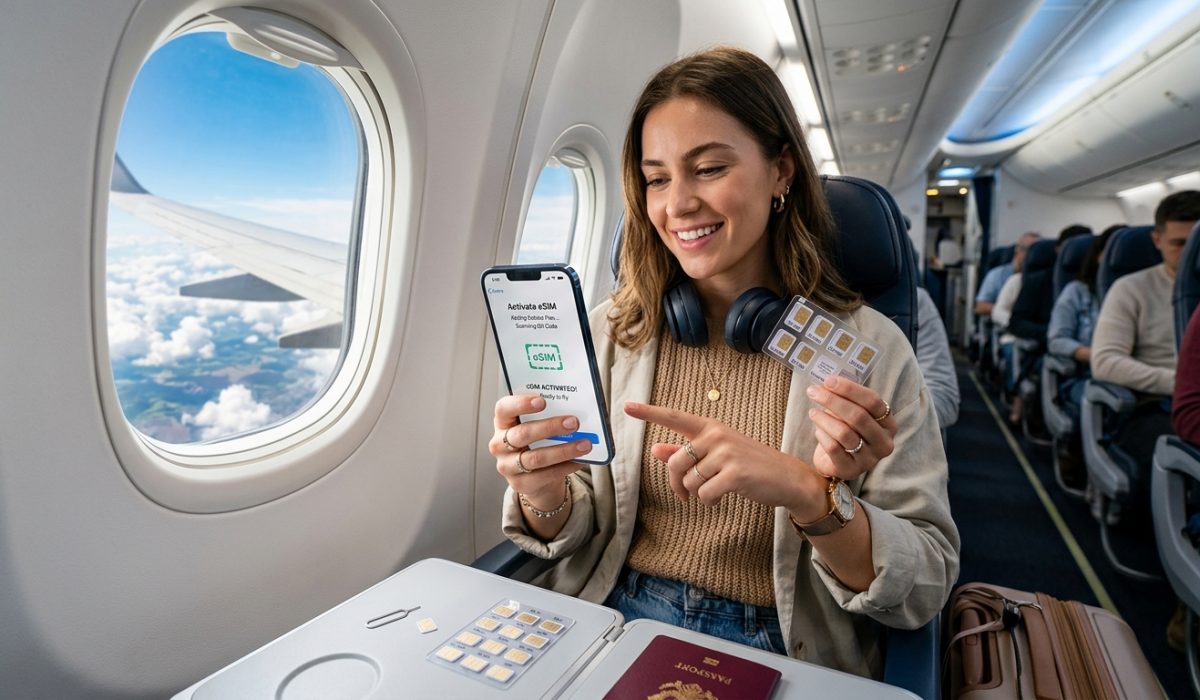
You land after a ten-hour flight. Your legs ache. Your carry-on is heavy. All you want is to message someone that you arrived safely. Instead, you’re scanning the arrivals hall for a mobile carrier kiosk, joining a slow queue, fumbling with a tiny SIM ejector pin, and watching your phone restart three times before you finally get signal. By that point, you’ve lost an hour you’ll never get back. This is the reality millions of travelers accept every single trip. But a growing number of frequent flyers have quietly made this ritual disappear entirely, and the secret is already built into their phone.
Key Points:
1. An eSIM activates before you board, meaning you land with data already working on your device.
2. Comparing activation time, cost, and dual-SIM flexibility reveals why embedded SIMs beat physical cards for most modern travelers.
3. Countries like Australia show how eSIM coverage now matches or outperforms traditional prepaid options in major travel destinations.
The Airport SIM Hunt Is a Tax on Your Time
Anyone who travels more than twice a year knows the drill. Research which carrier works in your destination. Pack a spare SIM ejector tool. Hope the airport kiosk is open when you land. Hope the staff speak enough of a shared language to help you pick the right data plan. Hope your phone accepts the card without complaining.
Even when everything goes right, you’ve spent real time and mental energy on a task that has nothing to do with why you traveled in the first place. You came to see a place, meet people, or get work done. Not to manage cellular hardware in a crowded arrivals terminal.
The problem compounds when you travel frequently. Each new country means repeating the same ritual. Each layover city might need its own solution. Each time you swap a physical SIM, you risk losing your home number temporarily, or worse, bending a pin and damaging your tray.
There is a better system now, and it has been sitting in most flagship smartphones since around 2018.
What an eSIM Actually Is
An eSIM is an embedded SIM, a small chip soldered directly into your phone’s motherboard. Unlike a physical card, it cannot fall out of your pocket, get bent in your bag, or be left behind at home. You manage it entirely through software.
You buy a data plan from a carrier or reseller. They send you a QR code or an activation link. You scan it or tap it. Within minutes, sometimes seconds, your phone connects to a local network in your destination country, even before you’ve packed your suitcase.
The eSIM standard is maintained by the GSMA, the global body that governs mobile network standards, and it is now supported by hundreds of carriers across more than 200 countries.
Why the Comparison Favors eSIM for Frequent Travelers
When you sit down and look at the numbers honestly, physical SIMs rarely win for travelers who move between countries more than a few times a year. The full breakdown of eSIM vs SIM covers this in detail, but here are the dimensions that matter most.
Activation Time
A physical SIM requires you to be physically present somewhere, either an airport kiosk, a carrier store, or a convenience shop in a foreign city. An eSIM activates from your couch the night before you fly. You land with working data.
Cost and Plan Flexibility
Physical prepaid SIMs often come bundled with call minutes you don’t need, or locked into a data amount that doesn’t match your trip length. eSIM plans from travel-focused providers tend to be data-only, priced by the gigabyte, and valid for exact trip durations. You pay for what you use.
Dual-SIM Capability
This is the feature that changes things most dramatically for frequent travelers. Most modern smartphones treat an eSIM as a second SIM slot. You keep your home number active on your physical SIM or your regular eSIM profile. Your travel data plan runs in parallel on a separate eSIM profile. You receive calls and texts from home. You browse on local data rates. No juggling. No missed calls.
- Your home number stays reachable throughout the trip
- Local data costs a fraction of international roaming rates
- You switch between profiles in settings, not with a pin tool
What Happens When You Store Multiple Profiles
Here is where eSIM technology genuinely changes the logistics of frequent travel. A single phone can store multiple eSIM profiles simultaneously, though only one or two can be active at a time depending on your device.
This means you can buy data plans for three upcoming trips in a single afternoon. The Europe plan sits dormant on your phone until your Paris flight. The Southeast Asia plan waits for your Bangkok layover. The Australia plan is ready the moment your long-haul lands in Sydney.
- Pre-loading profiles means zero connectivity gaps at arrival
- Profiles do not expire the moment they’re downloaded, only when activated
- Switching between stored profiles takes about fifteen seconds in settings
Australia as a Real-World Example
Australia is one of those destinations where this matters enormously. The country is the sixth largest on earth by land area. Once you leave the major cities, signal coverage becomes a genuine planning concern. Getting set up with the wrong carrier, or showing up without any plan at all, can leave you offline in places where being offline has real safety implications.
For travelers heading to Australia, the practical guide to staying connected in Australia walks through exactly which networks provide the broadest rural coverage, what data volumes make sense for different trip lengths, and how to activate before you touch down at Sydney or Melbourne.
The practical upshot is that Australia’s major networks, Telstra in particular, have some of the most extensive rural coverage on the planet. An eSIM tied to the right underlying network gives you access to that coverage without the airport queue. You step off the plane at Kingsford Smith already connected. You drive into the Blue Mountains with a working map. You reach the Kimberley with data already loaded and ready.
Australia also illustrates a broader point: the country where you most need reliable pre-arrival connectivity tends to be the country where the physical SIM hunt is most inconvenient. Large geography, time zones far from home, long drives with no towns in between. Getting your connection sorted in advance is not a convenience, it is a practical safety measure.
The Device Compatibility Question
The honest caveat in any eSIM conversation is that your phone must support it. Most flagship Android phones from Samsung, Google Pixel, and others, plus every iPhone from the XS forward, support eSIM. Budget Android phones and older devices may not.
You can check by going to your phone settings and looking for a “Mobile Plans” or “Add eSIM” option. If it exists, you are ready. If it does not, a physical SIM is still your path for now, and that is fine. But if you are due for a phone upgrade in the next year, eSIM compatibility is worth adding to your checklist.
The GSMA’s eSIM specification governs the technical standard that makes all of this interoperability possible between carriers and devices worldwide.
The Traveler Who Benefits Most
Not every traveler needs to switch today. A once-a-year beach holiday to a single resort destination with hotel WiFi might not justify changing habits. But if you recognize yourself in any of these situations, the switch pays off immediately.
You travel more than three times a year to different countries. You frequently have layovers in cities where you’d benefit from a data connection. You work remotely and depend on having a connection ready the moment you land. You travel to large countries where carrier choice affects rural coverage. You dislike carrying a small collection of foreign SIM cards in your wallet.
For travelers in those categories, eSIM is not a gadget novelty. It is a genuinely more efficient system.
Landing Ready Instead of Landing Scrambling
The best version of any trip starts the moment the wheels touch down, not an hour later when you finally get a working SIM. Frequent travelers who have made the switch describe it the same way: landing with data already working feels like having a small superpower.
You walk out of baggage claim and your map works. Your hotel’s confirmation message arrives. Your ride-share app finds your location. Your family knows you landed. None of this required a queue, a pin tool, a language barrier, or a restart.
The physical SIM served international travelers well for years. It earned its place. But the ritual of hunting for a local card on arrival belongs to a specific era of travel, and that era is ending. Your phone already contains the hardware to skip all of it. All that is left is using it.
