Part of our England guide.
England’s beaches range from the chalk stacks of Dorset to the tidal sands of Northumberland, and this guide pulls together 12 of the most worthwhile stops from our coverage. Each entry sticks to what you will actually see and do, with practical details on access, history, and nearby sights.
Related travel guides: Beaches In Wales, Things To Do In England, 30 Must Visit Places In Norfolk, Itineraries For England, Where To Eat In England, and Where To Stay In England.
The Absolutely Dramatic Coastline Of Devon, England
Devon’s coast splits into two distinct characters: the rugged, cliff-bound north and the softer, sandy south. On the north coast, the South West Coast Path clings to high headlands, dropping into steep combes where streams meet the sea. Here you will find the Valley of Rocks, a dry river valley with wild goats roaming the scree slopes, and the Victorian resort of Ilfracombe, where the harbour still works for fishing boats. South Devon is a different world: sandy beaches like Slapton Sands stretch for miles, backed by a freshwater lake that is a nature reserve. The geology tells a deeper story too—red sandstone cliffs in the east, grey granite around Bolt Tail, and layers of limestone near Plymouth. Tides matter here; at low water, rock pools open up along the south coast, exposing anemones, crabs, and the occasional starfish. For walkers, the coastal path is the spine of the region, with regular bus links between villages so you can walk one way and ride back.
Exploring Old Harry Rocks: The Jurassic Coast, England
Old Harry Rocks stand at the eastern end of the Jurassic Coast, a UNESCO World Heritage Site that stretches 95 miles from Dorset to East Devon. The chalk headland is a pair of stacks—Old Harry and his wife—plus a stubby stump that was once a full arch until it collapsed in the 20th century. You can walk to the rocks from the village of Studland, a 1.5-mile stroll along the cliff top that passes through National Trust land. The chalk here is pure white because it is made of tiny marine organisms, and the same layer runs all the way to the Needles on the Isle of Wight. From the viewpoint, you look west along the coast to Ballard Down and east across Poole Bay. If you want a longer walk, continue to Swanage, where the path drops down to the seafront past the Victorian pier. There is no admission fee to see the rocks, but parking at Studland is pay-and-display, with free spaces for National Trust members.
New England's Hidden Harbors
Across the Atlantic, New England’s coast hides working harbours that have not traded their character for souvenir shops. In Maine, the town of Camden is the classic postcard: schooners moored in a snug harbour, hills rising straight behind the docks, and a breakwater that extends a half-mile into the bay. Further down the coast, Rhode Island’s Little Compton offers a quieter scene—a single general store, a beach of fine grey sand, and a harbour that still lands lobsters daily. These are working ports first and tourist stops second. You can watch boats unload their catch, buy fresh seafood straight off the deck, and walk public footpaths between the water and the salt marshes. The best time to visit is early morning, when the light is low and the harbours are quiet. Many of these towns have historical societies that open their doors a few afternoons a week, with photographs and artefacts from the fishing and shipbuilding eras.
Visiting The Beautiful Bamburgh Castle And Farne Islands, England
Bamburgh Castle sits on a dolerite outcrop that has been fortified since the 6th century, when it was the seat of the kings of Northumbria. The current building is largely Victorian, restored by the industrialist Lord Armstrong, but the site’s history is written in the stone: a Saxon palace, a Norman keep, and a medieval great hall that was later used as a hospital. From the battlements, you look straight out to the Farne Islands, a group of up to 20 rocky islets that are a major seabird colony. Between May and July, puffins, guillemots, and kittiwakes nest here in the tens of thousands, and grey seals haul out on the rocks year-round. Boat trips leave from Seahouses, with some landing on Inner Farne to see the chapel and the lighthouse up close. The castle is open daily from spring to autumn, with a combined ticket available if you also want to visit the nearby RNLI museum, which honours the lifeboat hero Grace Darling. Parking is free at the castle but fills up fast by mid-morning in summer.
11 Must Visit Places In England | Cities, Beaches & Architecture
This roundup covers the essential stops for a first-time visitor, mixing urban energy with coastal calm. London needs no introduction, but the real value is in the free museums and the river walk from Tower Bridge to Greenwich. Bath delivers Roman baths and Georgian crescents, with the Abbey churchyard always busy. York’s city walls are the best way to see the medieval core, and the Shambles is worth the crowds for the overhanging timber frames. The Lake District offers the most dramatic scenery, with Windermere the easiest base for a first visit. In the southwest, St Ives combines a working harbour with the Tate’s outpost, while the Eden Project near St Austell shows how a former clay pit became a rainforest under giant domes. Cambridge and Oxford both reward a punt trip down their rivers, and the colleges are open to visitors outside term time. For a beach day, the white sands of Studland Bay in Dorset are hard to beat, and the cliffs at Beachy Head in East Sussex give the best cliff-top walk in the south. Finally, the city break favourite of Brighton offers a pier, a pebble beach, and the Royal Pavilion’s Indian-inspired domes.
How To Visit Mwnt Beach In Wales
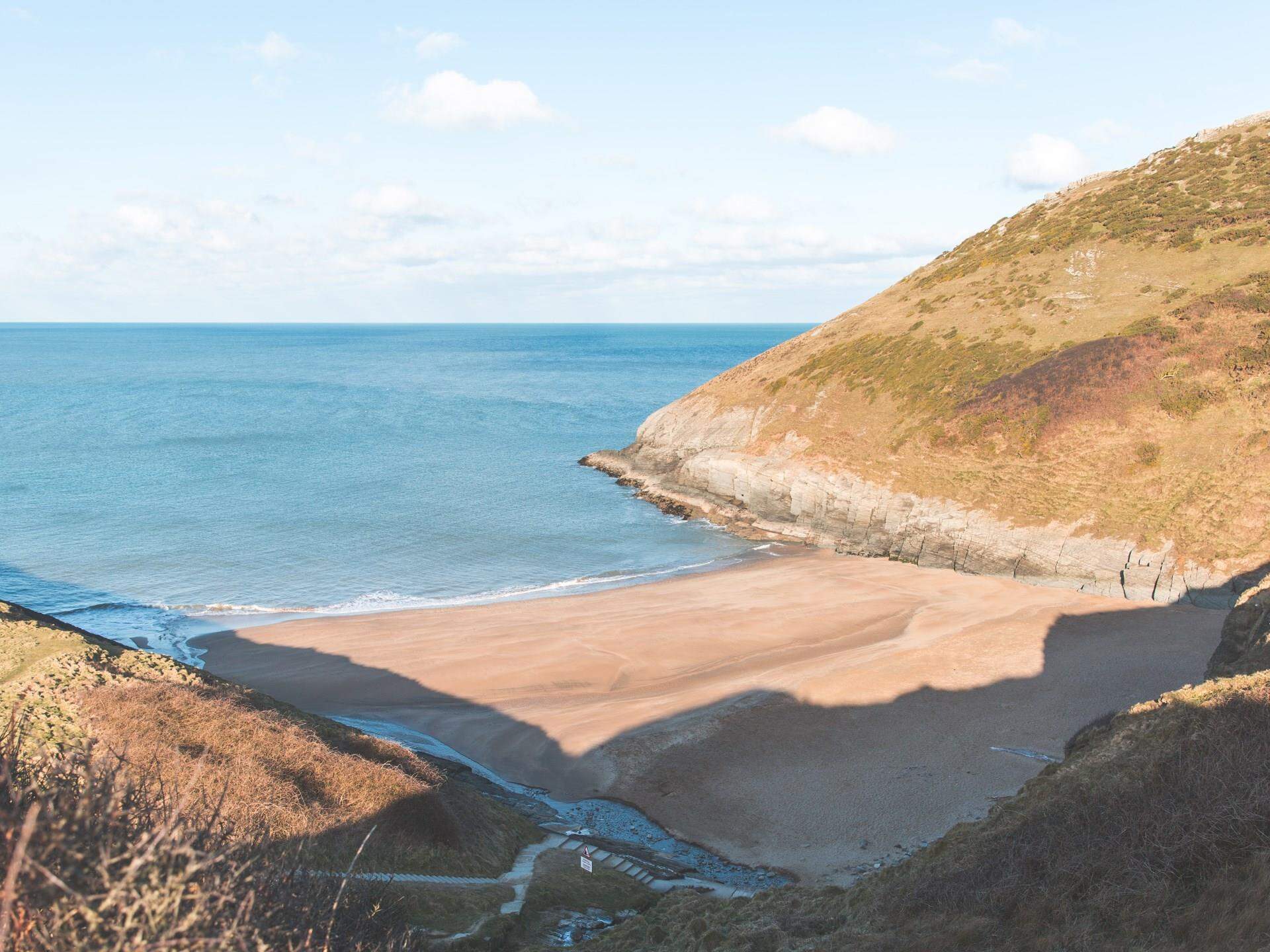
Mwnt Beach sits on the west coast of Wales, in the county of Ceredigion. The beach is enveloped by the rolling hills of the Ceredigion Heritage Coast. It is a small, sandy cove backed by steep grassy slopes. There is a National Trust car park at the top of the hill, and from there a path descends to the sand in about ten minutes. The water is clear and clean, but there are no lifeguards, and the beach shelves quickly, so it is not ideal for weak swimmers. At the southern end of the beach, a steep flight of steps cut into the cliff leads up to the 15th-century Church of the Holy Cross, a tiny whitewashed building still used for services. From the churchyard, the views along the coast are superb, and you can watch for porpoises and dolphins in the bay, especially in summer. Toilets and an ice-cream van operate in the car park during the season, but there are no other facilities, so bring your own food and water.
Visiting The Holy Island Of Lindisfarne, England
Lindisfarne is only an island twice a day. At low tide, a causeway opens up across the mudflats, and you can drive across to the village; at high tide, the sea covers the road, so you must check the tide times before you set out. The crossing takes about 20 minutes, and the safe crossing times are posted on signs at both ends of the causeway. Once on the island, the main sights are the ruined priory, founded in the 7th century by St Aidan, and the 16th-century castle, which sits on a rocky crag above the harbour. The priory’s most famous treasure was the Lindisfarne Gospels, now in the British Library in London, but the site itself is atmospheric, with the red sandstone arches still standing. The castle is run by the National Trust and requires a steep climb from the village, but the views over the island and the sea are worth it. The island also has a small museum, a few shops, and a pub that serves local crab and lobster. Plan to arrive at least two hours before high tide so you have time to explore without rushing, and remember that if you park on the mainland, you must move your car before the causeway floods.
Hilo's Lyman Museum And Big Island History
Hilo’s Lyman Museum offers the best single introduction to the Big Island’s human and natural history. The museum is housed in a restored 19th-century missionary home, and the exhibits cover everything from the formation of the Hawaiian Islands by volcanic activity to the arrival of Polynesian settlers and later missionaries. The first floor has a thorough geology section, with samples of the island’s rocks and minerals, including the rare green olivine sand from Papakolea Beach. Upstairs, the cultural exhibits include feather cloaks, wooden bowls, and a full-size replica of a traditional Hawaiian grass house. The museum also has a small but well-chosen collection of native Hawaiian bird specimens, many of which are now extinct or endangered. Allow at least two hours to see everything, and check the schedule for guided tours, which are included in the admission price. The museum is located in downtown Hilo, a short walk from the farmers market, so you can combine a visit with a stroll through the town’s historic buildings.
Ever Thought Of Visiting Burgh Island, Devon
Burgh Island is a tidal island off the South Devon coast, connected to the mainland by a sandy causeway that is passable for about four hours on either side of low tide. When the tide is in, a sea tractor—a raised platform on wheels—carries visitors across the water, a service that has run since the 1920s. The island is famous for its Art Deco hotel, which has hosted Agatha Christie, who wrote two of her mysteries here, and the island’s only pub, the Pilchard Inn, dates back to the 14th century. The island is small, about 2,000 feet long and 1,000 feet wide, so you can walk around it in under an hour. The main sights are the ruined chapel of St Michael, the old pillbox from World War II, and the beach at the island’s southern end, which is sheltered and good for swimming when the tide is in. The hotel offers cream teas and lunches to non-guests, but it is wise to book ahead in summer. Check the tide tables for the island, and aim to cross within an hour of low tide to be safe.
World War II Coastal Defenses
Before radar became reliable, acoustic mirrors were used to detect incoming enemy aircraft. These large concrete dishes, built in the 1920s and 1930s, were positioned along the coast to reflect sound waves from approaching engines. The largest surviving examples are at Denge in Kent, where a group of mirrors stands in a field, and at Sunderland in Tyne and Wear, where a single mirror overlooks the North Sea. The principle was simple: the dish focused sound onto a microphone, and an operator listened for the drone of engines. The system worked, but it was limited by background noise and the speed of sound, so it was quickly made obsolete by the invention of radar in the late 1930s. Today, the Denge mirrors are a scheduled monument, and you can walk to them from the car park at the nearby visitor centre. The site is free to visit, but access is across rough grass, so wear sturdy shoes. The mirrors are a striking sight—huge, curved walls of concrete, still standing exactly where they were built.
Hidden Smugglers' Coves Along New England's Rocky Shore
New England’s coast is riddled with small coves that were once used by smugglers to land untaxed goods—tea, rum, and textiles—in the 18th and early 19th centuries. Many of these coves are now accessible only on foot or by boat, which is exactly why they were chosen in the first place. One of the best examples is Pemaquid Point in Maine, where the rocky shoreline is broken by a series of narrow inlets, each with a small beach at the head. The local historical society has documented several of these sites, and you can pick up a map at the Pemaquid Point Lighthouse, which also offers a small museum. Another good spot is the Cape Cod National Seashore, where the Great Island Trail leads through pine forest to a hidden cove on the bay side. The trail is three miles each way, and the cove at the end is a quiet spot for a picnic, though there is no swimming because of the strong currents. For a guided experience, several kayak outfitters in Maine offer paddling tours that visit these coves, with a guide who knows the history of the smuggling trade.
Maine's Secret Coastal Gardens: New England's Largest Botanical Gem
The Coastal Maine Botanical Gardens in Boothbay Harbor is the largest botanical garden in New England, covering 295 acres along the coast. The gardens include a formal flower garden, a children’s garden with a giant whale’s tail slide, and a network of trails that wind through native forest down to the water. The highlight is the Lerner Garden of the Five Senses, where you are encouraged to touch, smell, and taste the plants. There is also a large collection of rhododendrons and azaleas, which bloom in late May and early June. The garden is open from April through October, and the admission fee is valid for two consecutive days, which is useful if you want to take your time. The on-site café serves lunch and snacks, and there is a well-stocked gift shop. The gardens are located about 10 minutes from the centre of Boothbay Harbor, and the road to the entrance is well signed. Plan to spend at least three hours here, and bring a camera—the views over the river and the coast are among the best in the state.