

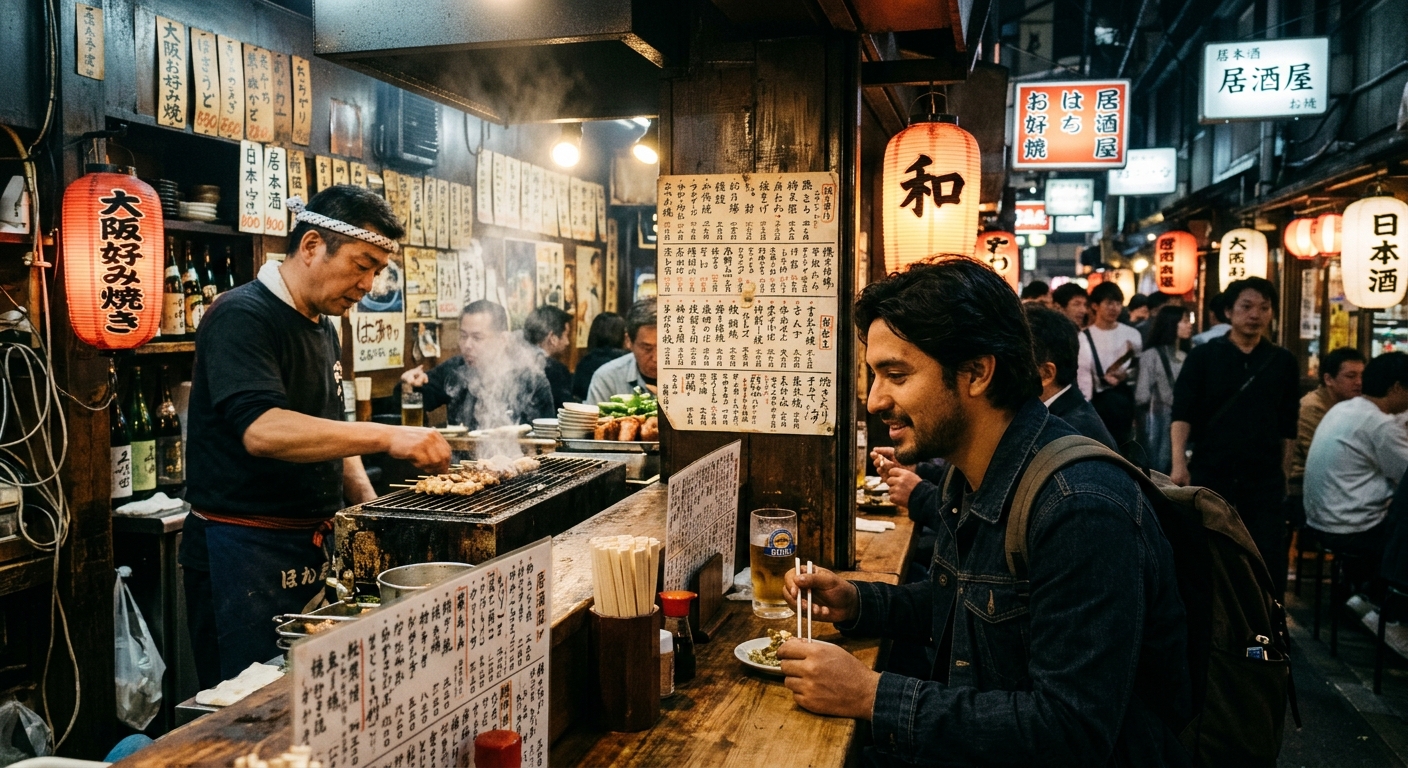
The curtain across the doorway is short. The counter inside seats eight. Something smells wonderful, but the handwritten menu gives you almost nothing you can read. This is where dinner in Osaka can become memorable. Small neighborhood restaurants reward a little patience, a few useful phrases, and a willingness to ask before ordering. You do not need fluent Japanese to enjoy them. You need a way to choose a place, understand its menu, and make your questions clear.
Your Seat at the Counter: Start with a small restaurant whose specialty you can identify, then check seating, prices, and ordering rules before settling in. Printed menus, wall strips, and handwritten boards each need a slightly different approach. Pointing and simple Japanese can handle an ordinary order. Ingredient restrictions need a separate conversation, with specific questions about broth, sauces, and cooking methods. Carry cash, keep luggage compact, and give a busy cook time to respond.
Find a Neighborhood Before Choosing a Doorway
Give yourself a manageable area rather than searching across the whole city while hungry. Around Tenma, streets near the station and the Tenjinbashisuji shopping arcade offer plenty of opportunities to compare small dining rooms. Fukushima is another useful area for an evening walk between restaurants. Around Nakazakicho, quieter lanes can suit a slower search, though some businesses focus on daytime service.
These neighborhoods have different moods, and none guarantees an empty seat or an English-speaking host. Walk a short circuit first. Look at displayed menus, note prices, and check whether a place serves full meals or mainly drinks with small plates. A tiny bar with appealing snacks may not suit someone seeking a substantial dinner without alcohol.
Choose your first restaurant around a recognizable specialty. An okonomiyaki restaurant narrows the choices to savory pancakes and related dishes. A noodle shop gives you another clear starting point. An izakaya can offer broader variety, but its menu may require more questions about portions and ingredients.
Do not judge access by atmosphere alone. A quiet room may have reserved seats. A crowded counter may have room for one person. The useful step is to pause at the entrance and let the staff decide where you can sit.
Read the Entrance Before Taking a Seat
A fabric doorway curtain, called a noren, can help you spot a restaurant, but it does not settle whether the kitchen is accepting customers. Check posted hours and signs. 営業中 means open for business. 準備中 means the restaurant is preparing or temporarily closed. Last orders can fall before the posted closing time.
At the door, hold up the number of fingers matching your group. For two people, say “Futari desu”, meaning “There are two of us.” For one, use “Hitori desu.” Wait for a gesture toward a seat. Keep bags off neighboring stools unless the staff offers that space.
If communication feels uncertain, ask “Eigo no menyū wa arimasu ka?”, meaning “Do you have an English menu?” A Japanese-only menu is an invitation to slow down, not a reason to pretend you understand everything. Have a translation screen ready, but begin with a greeting and eye contact.
Recognize the Menu Format in Front of You
In a small Osaka restaurant, the menu may be spread across several surfaces. The booklet on the counter might cover regular dishes. A board above the kitchen might carry today's fish. Paper strips on the wall may show individual items without pictures. Look around before assuming you have seen every option.
How Common Menu Formats Affect Your Order
| Menu Format | What to Look For | Useful Next Step |
|---|---|---|
| Printed booklet or sheet | Dish categories, sizes, sets, and separate drink sections | Point to the exact item and confirm the quantity. |
| Handwritten board | Daily specials, changing prices, and crossed-out items | Ask which dishes remain available. |
| Paper wall strips | Separate dish names, sometimes written vertically | Show the staff a clear image if pointing is ambiguous. |
| Ticket machine | Main dishes, extra toppings, portion sizes, and payment instructions | Choose and pay before sitting when the restaurant uses that system. |
A few written terms help you recognize the structure. 定食 means a set meal, typically combining a main dish with accompaniments. 単品 means an individual item ordered separately. 盛り合わせ means an assortment. 時価 means market price, so ask the cost before ordering. 税込 means tax included, while 税別 means tax excluded.
Portions deserve attention too. A price may apply to one skewer, one plate, or a minimum order of several pieces. Ask “Kore wa hitori-bun desu ka?”, meaning “Is this one person's portion?” That is more useful than guessing from a neighboring table's order.
Use a Menu Photo to Narrow Your Choices
Handwriting can defeat even a carefully prepared traveler. Chalk strokes blur, regional dish names look unfamiliar, and a translated phrase may still tell you little about dinner. When that happens, travelers can translate menu text from a photo to identify likely ingredients and choose a few dishes worth asking about.
Ask before photographing a board inside the restaurant. Keep other diners out of the frame and avoid leaning over anyone's meal. Photograph one section at a time, straight on, with enough detail to capture both the dish name and its price. A wide image of an entire wall often produces muddled results.
Treat the translation as a starting point. A dish name may refer to a cooking style rather than its complete ingredients. Sauces, stock, garnishes, and seasonal substitutions may be absent from the wording. Show the original Japanese text when confirming an order, especially if the translated result sounds strange.
Order Clearly Without Holding Up the Counter
A short, complete request is easier to handle than several unfinished questions. Choose your first dish before calling someone over. A polite “Sumimasen”, meaning “Excuse me,” is a normal way to attract attention. Speak at a conversational volume and wait for acknowledgment.
-
Point to the item. Say “Kore o hitotsu kudasai”, meaning “One of this, please.” Keep your finger beside the dish name so the staff can see it.
-
Confirm the amount. State how many plates or pieces you want. If the menu gives a minimum order, check that before adding more dishes.
-
Ask any ingredient questions. Finish this conversation before the order goes to the kitchen.
-
Let the staff repeat the order. Listen, watch where they point, and correct misunderstandings immediately.
For a recommendation, ask “Osusume wa nan desu ka?”, meaning “What do you recommend?” Give the question some boundaries if needed. Mention that you want something cooked, a small portion, or a dish without meat. A general recommendation does not communicate a dietary restriction.
At an izakaya, ordering a few dishes and adding more later can work nicely. At a restaurant serving set meals, choose your main order together. Follow the room's pace rather than assuming every restaurant operates the same way.
Ask About Ingredients Beyond the Dish Name
A vegetable dish can contain fish stock. A meat-free topping does not tell you what is in the broth. In Osaka, dishes served with sauces and garnishes can require several separate questions. Okonomiyaki, for example, may involve ingredients in the batter as well as toppings added at the end.
For a general ingredient question, use “Kore ni nani ga haitte imasu ka?”, meaning “What is in this?” For a specific ingredient, “Ebi wa haitte imasu ka?” asks “Does it contain shrimp?” Replace ebi with the ingredient you need to check, ideally showing its written Japanese name too.
If you avoid fish, ask about dashi, the stock used in many Japanese dishes. “Kono dashi wa nan de totte imasu ka?” means “What is this stock made from?” Ask separately about bonito flakes, sauces, and toppings. Removing something from the finished plate cannot remove it from a prepared broth.
For an allergy, carry an accurately translated card naming the allergen and explaining your requirements. “Ebi arerugī ga arimasu” means “I have a shrimp allergy.” Show the card before ordering and ask about shared oil, utensils, and cooking surfaces where relevant. A photo translation cannot establish whether a meal is safe.
Give the staff room to say they cannot accommodate you. Small kitchens may use premixed sauces or have little space to separate preparation. If the answer remains unclear, choose another restaurant. That decision is easier before cooking begins.
Understand Small-Restaurant Charges and Counter Etiquette
An unrequested appetizer can surprise visitors at an izakaya. It may be an otoshi, also called tsukidashi in the Osaka area, with a charge attached. Official dining etiquette guidance advises checking cover fees with staff and notes that tipping is not customary in Japan.
Ask about a seating or appetizer charge before settling in if your budget is tight. You can say “Sekiryō wa kakarimasu ka?”, meaning “Is there a seating charge?” Check any required drink order too. Do not assume that declining the appetizer removes a charge.
At the counter, keep your belongings within your space. Use the provided towel for your hands. Place chopsticks on their rest when available, and use serving utensils for shared food. Ask before photographing the cook or other guests.
If you are eating at a standing bar, watch where bags belong and leave passage space clear. In a small room, practical consideration matters more than performing perfect etiquette. A quiet voice and attention to staff instructions go a long way.
Pay Smoothly and Leave With a Thank-You
Carry enough yen for dinner, since payment options vary. Check card acceptance before ordering if cash is limited. Ask “Okaikei onegaishimasu”, meaning “The bill, please,” and follow the staff's direction about paying at your seat or a register.
For a group, be ready to make one payment unless separate payments are accepted. Check the total while you are still at the counter. If something is unclear, point to the line and ask calmly. A drink, appetizer charge, or extra portion may explain the difference.
As you leave, “Gochisōsama deshita” is a courteous thank-you for the meal. You do not need perfect pronunciation. Say it clearly, collect your belongings, and make room for the next guest.
Make the Next Small Door Easier to Open
Your first Japanese-only dinner in Osaka may involve pointing, a translated photo, and a question asked twice. You can still leave having eaten something excellent and understood what you ordered. Start with a recognizable specialty, check prices and ingredients, and keep your requests simple.
By the next evening, the wall strips may feel less mysterious. You will know how to ask for a seat, recognize a set meal, and confirm what is in the broth. That small amount of confidence gives you more freedom to choose a restaurant because its food interests you, even when the menu takes a little work.
